
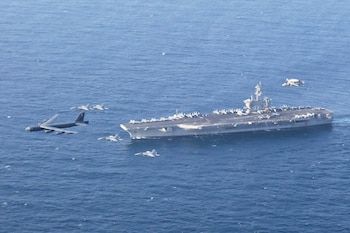
A naval contingent larger than the one that was deployed against Venezuela and led by the aircraft carrier Abraham Lincoln operates under the directives of the president, who warned of possible quick actions and recalled the “Midnight Hammer” operation.
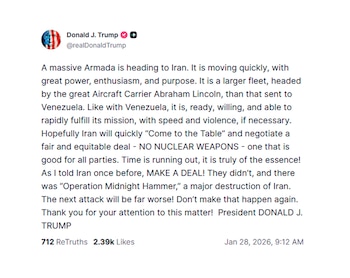
US President Donald Trump announced the dispatch of a large military fleet to Iran and warned that time to negotiate a fair nuclear deal is running out. In a message posted on the Truth Social network, Trump stated: "A massive armada is headed to Iran. It moves quickly, with great power, enthusiasm and purpose. It is a larger fleet, led by the great aircraft carrier Abraham Lincoln, than the one sent to Venezuela."
The president stressed that the fleet is prepared to fulfill its mission “with speed and violence, if necessary,” and urged the Iranian regime to sit down to negotiate a “fair and equitable: without nuclear weapons, one that is good for all parties.” Trump concluded: “Time is running out, it is truly of the essence.”

The American president recalled that, during a previous occasion when Iran did not agree to negotiate, the so-called “Operation Midnight Hammer” was carried out, which, in his words, caused great destruction in Iran. Trump warned: "The next attack will be much worse. Don't let that happen again."
Earlier, the Iranian Deputy Foreign Minister, Kazem Ghariabadi, said in a meeting with the foreign press in Tehran that his country's regime considers “war more likely than negotiation” following the increase in tension. "We are preparing for the worst scenario. The priority is to defend the country," said Ghariabadi. The diplomat explained that Iran will respond “strongly to any aggression” and that, if the United States carries out a limited attack, the response will be “appropriate.”

Ghariabadi warned that any place from where an attack against Iran originates, or from where American fighters take off, will be considered a “legitimate target.” Furthermore, he indicated that the United States must change its approach and seek real negotiation and that, although the channels of dialogue remain open, there are currently no ongoing conversations. The vice minister stressed the importance of Washington's seriousness in a possible dialogue and warned that Iran will only agree to sit down to negotiate with authority and a firm posture.
The US military deployment comes after the US Central Command (Centcom) confirmed the presence of the USS Abraham Lincoln aircraft carrier and its battle group in the Middle East, following Trump's announcement and in response to the repression of protests in Iran. Although the most intense demonstrations occurred on January 8 and 9 and have been quelled, Trump decided to maintain the order to send the fleet.

This Tuesday, the Iranian Armed Forces warned that the presence of a United States aircraft carrier and other ships in the Middle East increases their "vulnerability" and turns them into "reachable targets", in a context of growing bilateral tension marked by internal protests in the Islamic Republic and a reinforcement of the US military deployment in the region.
“The concentration and accumulation of forces and equipment in the area will not be a deterrent factor, but will increase their vulnerability and turn them into targets within reach,” said a military source at the Khatam al Anbiya Base, the unified central command of the Iranian Armed Forces, according to Iranian state television.

The source, whose name was not made public, maintained that the idea of carrying out a “limited, quick and clean operation against Iran is due to incorrect estimates and an incomplete understanding of the Islamic Republic's defensive and offensive capabilities.”
The Islamic Republic warned that it will respond to any intervention and that all US bases in the region will be considered military targets if an attack occurs. Additionally, the Iranian government accused the United States and Israel of organizing the protests, calling them “terrorist.” Iranian authorities put the death toll in the protests at 3,117, while opposition non-governmental organizations such as HRANA estimate the figure at around 6,000.


0 Comments