
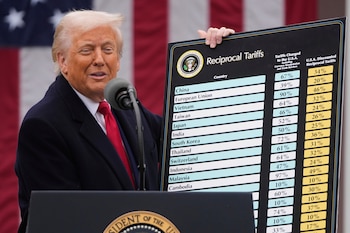
U.S. Supreme Court Strikes Down Donald Trump’s Tariffs in Landmark 6–3 Ruling
Washington, D.C. — In a decision with sweeping political and economic implications, the Supreme Court of the United States on Tuesday invalidated the “reciprocal” tariffs imposed by President Donald Trump, ruling that the executive branch overstepped its constitutional authority in matters of taxation.
The 6–3 ruling held that the power to levy taxes and duties rests with Congress and cannot be exercised unilaterally by the president. “The Framers of the Constitution did not vest any portion of the taxing power in the Executive,” the majority opinion stated, underscoring the constitutional limits of presidential authority over trade policy.
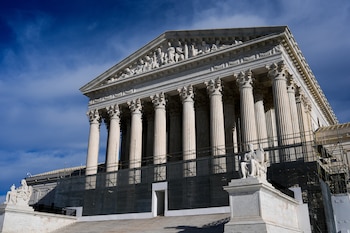
La sede de la Corte Suprema de Estados Unidos en Washington. (AP foto/Julia Demaree Nikhinson)
A Major Blow to the “Reciprocal Tariffs” Strategy
The case centered on broad tariffs applied to goods from nearly all U.S. trading partners. The Trump administration had defended the measures as necessary to address trade imbalances and respond to what it described as unfair foreign practices.
However, the Court’s majority concluded that while Congress may delegate certain powers, it cannot hand over core taxing authority without clear and defined limits. Allowing such expansive executive discretion, the justices wrote, would disrupt the balance of powers carefully constructed in the Constitution.
Sharp Division on the Bench
The three dissenting justices argued that existing trade statutes provided sufficient authorization for the executive branch to act and that courts should defer to presidential judgments in matters of economic policy and national security.
The 6–3 split reflects a Court deeply engaged in defining the boundaries between the legislative and executive branches, even as it remains ideologically divided.
Economic and Political Fallout
The ruling is expected to have immediate consequences for U.S. trade policy and global markets. Businesses affected by the tariffs may now seek reimbursement, while lawmakers could face renewed pressure to clarify the scope of presidential authority in trade disputes.
Politically, the decision represents a significant setback for Trump, whose economic strategy relied heavily on tariffs as leverage in international negotiations.
A Constitutional Reaffirmation
Beyond trade, the ruling serves as a forceful reaffirmation of Congress’s central role in taxation. Constitutional scholars say the decision could become a defining precedent for future administrations, setting clear boundaries on how far presidential power can extend without explicit legislative backing.
With this judgment, the Supreme Court has not only reshaped U.S. trade policy but also reinforced the foundational principle of separated powers at the heart of American democracy.


0 Comments