

The President of the United States is executing his geopolitical plan to end dictatorships in the region, leveraging a strategic resource he controls from the White House.
Donald Trump has established an economic and diplomatic mechanism that allows him to control the Venezuelan dictatorship from the White House and advance his plan to overthrow the Cuban regime led by Miguel Díaz-Canel in Havana.
Trump's geopolitical decisions are implemented by Marco Rubio, the Secretary of State, who has a direct line of communication with Delcy Rodríguez, Nicolás Maduro's successor in the Miraflores Palace.
In turn, Rubio is in dialogue with María Corina Machado, an icon of the Venezuelan opposition, to avoid internal political friction in Venezuela that could complicate Trump's roadmap, while Rodríguez explains to Diosdado Cabello and Vladimir Padrino, heads of the repressive apparatus, that their survival depends on the tolerance of the US president.
The Republican administration's offensive is impacting the stability of the Cuban dictatorship run by Díaz-Canel. Venezuelan oil is essential for the communist regime, and in the current geopolitical context, Rodríguez, Cabello, and Padrino have opted for their own self-preservation.
Trump's plan to control the Venezuelan dictatorship is based on the public and private efforts of Marco Rubio, the Treasury Department, the Department of Energy, Sheikh Tamim bin Hamad Al Thani, the Emir of Qatar, and the oil companies Trafigura and Vitol.

The Venezuelan dictatorship's finances are exhausted, and Rodríguez has agreed with Rubio to provide the Secretary of State with a monthly budget to sustain the Caribbean regime.
Rubio will analyze the funds to be granted and present the overall figures to Trump, who will make the final decision. With the authorization of the US president, the financial contribution will be transferred to the Miraflores Palace. “Venezuela urgently needed money to finance the police, sanitation workers, and the daily operations of the government,” Rubio stated in the Senate, explaining this financial mechanism.
The Secretary of State added: “They have committed to using a substantial amount of those funds to purchase medicines and equipment directly from the United States.”
If Rodríguez complies with Trump's instructions, the dollars will arrive in Caracas. If he doesn't, Washington will tighten the noose and design a new attack on the Venezuelan dictatorship.
The companies Trafigura and Vitol are responsible for marketing Venezuelan oil. These are two global players with access to the White House and are in constant contact with the U.S. Department of Energy.
“At the request of the U.S. government, Trafigura and Vitol are providing logistics and marketing services to facilitate the sale of Venezuelan oil.
Trafigura's scale and capabilities, as one of the world's largest independent oil traders, along with our global shipping fleet and logistics network, position us among the few companies capable of executing an operation of this size and complexity efficiently. Trafigura operates in full compliance with applicable sanctions and has all the necessary licenses to carry out these transactions," Trafigura's press office responded to an inquiry from Infobae.
This sentence from the oil company's statement is key: “Trafigura operates in full compliance with applicable sanctions.”
In other words: the fewer US sanctions on Venezuelan oil, the more business and more millions of dollars to supply the finances of the Caribbean dictatorship.
In return, Delcy Rodríguez must keep the regime stable, continue with the release of political prisoners, and fulfill Trump's main objective: achieving a democratic transition in Venezuela.
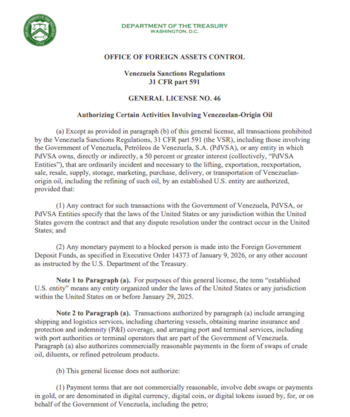
In this regard, OFAC—an arm of the Treasury Department that enforces trade sanctions—eased measures against the dictatorship run by Rodríguez yesterday.
In the machinery designed by Trump to control Venezuela, there is a fundamental piece: the Qatari Emir Tamim bin Hamad Al Thani, who has a relationship of absolute trust with the President of the United States.
Al Thani agreed that Qatar would manage a bank account where the funds obtained from the sales of Venezuelan oil, which Rodríguez provides and which Trafigura and Vitol companies market, are deposited.
In this way, the United States prevents international embargoes from being applied to recover the investments of the oil companies that were seized by Hugo Chávez at the beginning of his dictatorship.
“I understand that it's unconventional, but it's the best we could achieve in the short term,” Rubio argued when asked about the account managed by Qatar.
Trump is satisfied with his political relationship with Delcy Rodríguez, and the status quo will remain until...
unless the White House decides otherwise.


0 Comments