
Slab City is located in the heart of the Sonoran Desert, California. There, people gather who seek to escape capitalism. The motto of the inhabitants is "live and let live."
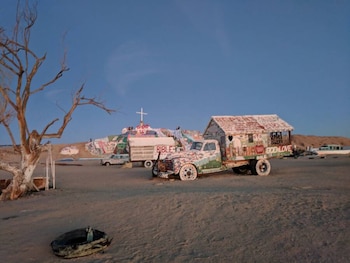
The heat is relentless in the Sonoran Desert, California. Under an improvised awning, a man with a white beard and blue eyes—whom everyone calls Wizard—patiently smokes his pipe. He guards the entrance to East Jesus, in Slab City, an open-air museum where the world's waste is transformed into art and rules become superstition.
You might be interested in:
Beatrice Cenci: a young woman tormented by her father, a plea for help that went unanswered, and the desperate act that led her to the gallows
Slab City doesn't appear on tourist maps. Nor in censuses. It stretches across the concrete slabs left behind by Camp Dunlap, a military base dismantled in 1956, about 320 kilometers from Los Angeles. Here, the asphalt ends and everything is sand. A place without electricity, without running water, without taxes or laws, where the only motto is simple and brutal: "live and let live."
The town of freedom
At the entrance, a sign reads: "Welcome to Slab City. The last free place in America." All you have to do is find a piece of unclaimed land, park your RV or build a shelter with wood and canvas. There are no property titles, no contracts, no promises. The territory belongs to whoever dares to stay.
Life in Slab City is an exercise in resilience. The thermometer can climb to 50° Celsius in the summer. When that happens, most visitors pack their things and leave. Only about 150 permanent residents remain to face the desert, the silence, and the darkness. "The safest thing to do is stay still," warns a woman with disheveled hair, who was once a marketing executive in Seattle and now rummages for clothes among forgotten bags.
Water doesn't flow from any tap. Water has to be hauled in tanks, brought from nearby canals, or obtained through community generosity. The public shower—fed by a thermal spring—is the only shared luxury. For electricity, everyone invents their own system. There are solar panels, recycled batteries, and generators. Those who can't manage it themselves seek out Solar Mike, a local veteran who has been installing solar systems since the 1980s.
Drugs and alcohol in Slab City
The most common drug is crystal meth, alcohol is always available, and although the police from Niland—the nearest town—patrol occasionally, true justice here is social. Theft is punished with moral exile and the contempt of neighbors. "Don't meddle in other people's business, unless you get robbed," summarizes George Sisson, host of a local Airbnb and one of the few with an entrepreneurial spirit.
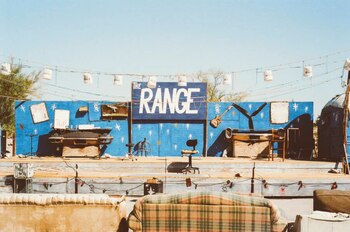
At night, darkness takes over the camp. The only light comes from campfires, flashlights, and makeshift solar systems. To combat boredom, the community has invented its own forms of entertainment: concerts at The Range—the vital center of Slab City—New Year's parties that last a week, clandestine raves, and movie screenings on improvised screens.
Slab City is also a sanctuary for outsider art. The undisputed jewel is Salvation Mountain, a multicolored artificial hill covered with biblical messages and crowned by a cross. It was the life's work of Leonard Knight, a migrant from Vermont who arrived in the 1980s with a hot air balloon and stayed forever when the device refused to fly. "Love Jesus and keep things simple," Leonard would repeat, paintbrush in hand, as he used thousands of gallons of donated paint. Knight died in 2014, but his mountain continues to receive pilgrims, curious visitors, and artists.
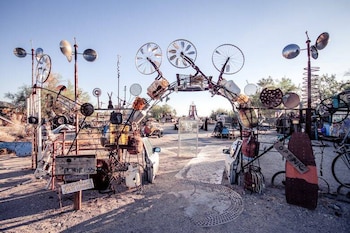
Charlie Russell arrived here after a cancer diagnosis, abandoned his life as an engineer, and founded a theme park of the absurd: customized cars, geodesic domes, and metal and wood sculptures. The Population of Slab City
In Slab City, retirees, travelers, hippies, artists, people with mental health issues, former executives, and dropouts from capitalism live side by side. Some arrived by conviction, others out of necessity or because their savings only stretched to a vehicle and a little shared food. The motto is to survive—and, if possible, to find beauty in what others call waste.
In Slab City, waste is transformed into sculptures, spaces are cared for, and security depends on kindness and mutual respect. Everyone lives in their own world, and as long as they don't bother their neighbors, the system works.
The parties at The Range, the gatherings at the bookstore, and the makeshift bars are places of community where music, theater, and poetry mingle with the desert sand.
In winter, the population exceeds 4,000 inhabitants. Caravans, RVs, and tents line up on the concrete slabs, forming informal streets that disappear when the heat arrives. No one pays rent, no one collects taxes. The land nominally belongs to the state of California.
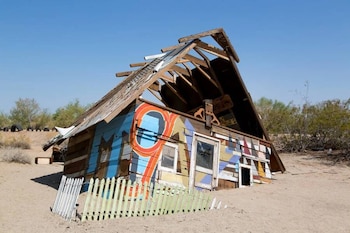
A stroll through the dusty streets reveals houses painted in impossible colors, mutant vehicles that look like they've come straight out of Mad Max, and religious messages competing with anarchist graffiti. On every corner, a story: a retiree stretching his pension, a couple of artists who recycle metal and glass, a motorcyclist seeking anonymity. The desert levels everything.
Stories circulate orally and become legends. The woman who arrived with a suitcase and ended up running The Range, the man who survived three summers on only water and cans of beans, the artist who restored the largest sculpture in exchange for a little gasoline.
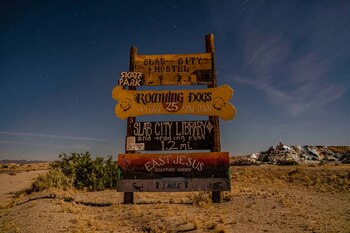
In the most remote area, East Jesus flourishes as a radical experiment. The city's rules—if they exist at all—are spray-painted on dilapidated doors: "Don't litter"; "Respect the art"; "Whatever you bring, take it with you when you leave." Every visitor is welcome if they respect the space, but the collective memory does not forgive the disrespectful. The art is recycled, destroyed, and renewed each season, in a constant mutation that defies the idea of ownership.
The Slab City Scene
Music is another of Slab City's languages. Every Saturday, The Range transforms into an improvised amphitheater. On a wooden stage, musicians take turns playing guitars, drums, and harmonicas. The audience is diverse: residents, tourists, backpackers, curious onlookers, and the occasional fugitive. Alcohol circulates in shared bottles, and laughter mixes with the sound of coyotes.
On the hottest days, the camp looks like a ghost town. Only the most resilient—or those with nowhere else to go—remain.
The nearest hospitals are in Brawley or El Centro, more than 60 kilometers away. Those who fall ill must rely on the solidarity of others or their own strength.
The bookstore, run by Cornelius, a former literature professor, is one of the few havens from the midday heat. Between makeshift shelves, books are piled high alongside letters, photographs, and a few handwritten poems. A hand-painted sign warns: "No Wi-Fi, talk to each other."
Outside, the desert engulfs everything in Slab City. The dust seeps through every crack, clings to the skin, and gets into the food. But it also leaves room for the imagination.


0 Comments