

The communications blockade and the closure of critical media outlets accompany an increasingly violent state response to a social uprising that combines economic crisis, political repression, and growing international isolation.
The brief reappearance of critical voices from Iran, after weeks of almost total internet blackout, once again highlighted the magnitude of the repression unleashed by the regime amid the most serious protests in recent years. “Tehran smells of death,” journalist Elaheh Mohammadi wrote on the social network X, in one of the few messages that managed to leave the country despite the restrictions imposed by the authorities.
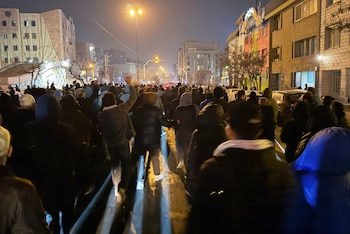
Mohammadi, a reporter for the Ham-Mihan newspaper, explained that for two days it was possible to access the internet intermittently using virtual private networks (VPNs), a common practice among Iranian journalists and activists when the state blocks communication services. “In all my life I have never seen it snow in Tehran and no one smiling,” she added, in a description that portrays the climate of fear and paralysis that grips the capital.
Internet access has remained severely restricted since January 8, when the Iranian regime decided to tighten digital control to curb the spread of the protests. According to human rights organizations and international agencies, the blackout aims to isolate the population, hinder the coordination of demonstrations, and limit the dissemination of images and testimonies about the violence perpetrated by the security forces.

The protests began on December 28 in Tehran, initially driven by merchants and urban sectors affected by the collapse of the Iranian rial, persistent inflation, and deteriorating living conditions. In a few hours, the economic slogans gave way to a direct questioning of the political system of the Islamic Republic, with demonstrations spreading to dozens of cities and provinces.
The regime's response was immediate and brutal. Security forces, Basij militias, and police forces acted with live ammunition, mass arrests, and military deployments in urban areas. The US-based organization Human Rights Activists News Agency (HRANA) reported that it has verified nearly 4,000 deaths linked to the repression, while almost 9,000 other deaths remain under investigation. An Iranian official, for his part, confirmed to Reuters that more than 5,000 people have died during the protests.
The name of Elaheh Mohammadi is no stranger to state repression. In 2022, her journalistic work gained international notoriety after she was one of the first to report on the death of Jina Mahsa Amini, the young Kurdish woman who died in police custody after being arrested for allegedly violating the strict dress code imposed on women. That case triggered a wave of protests that were met with arrests, summary trials, and harsh sentences.
Mohammadi and her colleague Nilufar Hamedi, from the Shargh newspaper, were accused of acting as foreign agents and convicted in judicial proceedings questioned by international organizations. Both were finally pardoned in February of last year, a measure interpreted by analysts as a tactical gesture by the regime in response to external pressure, rather than a structural change in repressive policy.
The situation of the independent press remains extremely fragile. This week it was reported that Ham-Mihan was forced to suspend its operations due to its critical coverage of the events. “We have tried all these days to write about the dead and the wounded,” Mohammadi wrote on X, in a message that summarizes the limitations imposed on the practice of journalism in the country.
The economic backdrop exacerbates the political scenario. The Iranian rial has accumulated years of depreciation, affected by international sanctions, mismanagement, and financial isolation. The World Bank and the International Monetary Fund have repeatedly warned about the impact of inflation on households, especially in urban areas and among young people, who are at the forefront of many of the protests. While the regime insists on portraying the demonstrations as riots instigated from abroad, the information blackout and the closure of critical media outlets reinforce the perception of a state that is responding to the crisis with more control and less transparency. The persistence of the protests, despite the repression and digital isolation, suggests that social unrest in Iran has reached a point that cannot be reversed solely through force.


0 Comments