

The head of the National Security Council, Ali Larijani, stated that there are contacts with Washington amid the growing tension between the two countries.
The Iranian regime acknowledged on Saturday "progress" towards a possible nuclear negotiation with the United States, in a context of increasing military tension and mutual warnings. The announcement coincides with the deployment of reinforcements in key areas such as the Strait of Hormuz and the Arabian Sea.
After meeting in Moscow with Russian President Vladimir Putin, the head of Iran's National Security Council, Ali Larijani, stated on X that the international perception of a lack of dialogue is due to "war propaganda" and assured that "the implementation of a negotiation framework is progressing." He did not specify deadlines or conditions, but emphasized the possibility of a rapprochement despite the hostile atmosphere.
From Washington, President Donald Trump confirmed that he has given Tehran an ultimatum to reach an agreement on the Iranian nuclear program, although the specific deadline was not made public. "I can say this: they want to reach an agreement," Trump declared at a press conference, adding that only the Iranian authorities know the imposed time limit and warning that the margin for negotiation is limited.
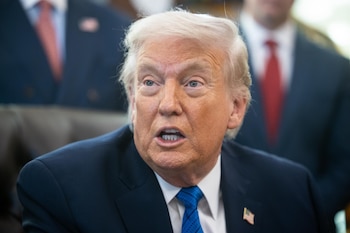
Trump stressed that the United States keeps "all options" on the table if dialogue fails and emphasized the strength of the US fleet in the region. However, he expressed his preference for an understanding that avoids the military option.
For its part, Iran, through figures such as Foreign Minister Abbas Araqchi, reiterated that the country will only agree to resume talks if its defensive capabilities and ballistic missiles are excluded from the negotiations. Araqchi declared in Istanbul, quoted by IRNA, that "we will preserve and expand our defensive capabilities to the extent necessary to defend the country." The diplomat stressed that there are currently no formal negotiations and that any dialogue must avoid pressure or threats. However, in a more confrontational tone, Iranian Army Chief Amir Hatami warned that his country's armed forces are "fully prepared" to respond to any American aggression: "If the enemy makes a mistake, there is no doubt that it will jeopardize its own security, the security of the region, and the security of the Zionist regime."
U.S. demands for progress in the dialogue focus on halting the development of Iran's missile program, a demand repeatedly rejected by the political and military leadership of the Islamic Republic. Tehran, in turn, conditions any significant agreement on the prior lifting of sanctions.
The military deployment in the region has intensified. According to The New York Times, the U.S. Navy maintains the aircraft carrier Abraham Lincoln in the Arabian Sea, accompanied by three warships equipped with Tomahawk missiles, F-35 fighters, and F/A-18 aircraft. This naval group, under the control of U.S. Central Command, operates on high alert and with the capacity for immediate attack on potential targets in Iranian territory if ordered by Trump, as part of his deterrence strategy and to safeguard critical trade routes in the area.

U.S. Central Command warned Iran's Revolutionary Guard that it "will not tolerate" "unsafe" military maneuvers in international waters, especially during the naval exercises planned in the Strait of Hormuz, a key passage for global energy transit. The United States considers both close overflights and aggressive approaches by Iranian vessels to its personnel or military equipment dangerous, insisting that such conduct increases the risk of incidents and regional instability.
In response, Iran announced two-day naval maneuvers with live fire in the Strait of Hormuz. IRNA confirmed that the Revolutionary Guard is conducting these exercises with the aim of strengthening national defense against any scenario. The timing of the exercises comes shortly after the United States and the European Union included the Guard on their list of terrorist organizations, a designation rejected by Iranian authorities. On the diplomatic front, countries such as Turkey, the United Arab Emirates, and Saudi Arabia intensified their efforts to de-escalate the situation and prevent armed conflict. The arrival of a US destroyer at the port of Eilat in Israel reinforces the international military presence in this strategic area, crucial for the global flow of oil and gas.
This standoff between Washington and Tehran is unfolding against a delicate domestic backdrop for Iran. Despite international pressure, the authorities in Tehran maintain that defending their nuclear program and promoting national scientific and technological development remain their top priorities. In this regard, the Iranian regime asserts that its progress in nuclear science and technology will continue.
unwavering, thus reflecting a firm stance on preserving its achievements even under the most direct threats.


0 Comments