
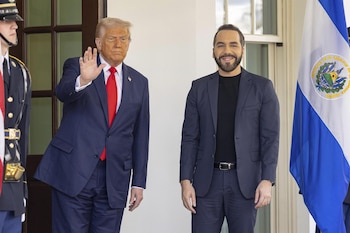
Trump Calls Summit in Miami with Latin American Allies to Counter China's Regional "Offensive"
By Anastacio Alegría — February 11, 2026
Former US President Donald Trump officially announced on Wednesday a presidential summit for March 7 in Miami, designed to forge a political and strategic front with several Latin American governments in response to China's growing influence in the region.
The meeting, to be held at the Doral Hotel in Miami, has been extended to leaders such as Javier Milei (Argentina), Santiago Peña (Paraguay), Rodrigo Paz (Bolivia), Nayib Bukele (El Salvador), Tito Asfura (Honduras), and Daniel Noboa (Ecuador), all considered political allies or aligned with the geopolitical agenda promoted by Trump and his conservative supporters in Washington. ([infobae][1])
**A Strategic Response to China**
The initiative is part of a growing rivalry between the United States and China for economic and political influence in Latin America. In recent decades, Beijing has significantly increased its presence in the region through investments in infrastructure, energy, telecommunications, and bilateral trade, becoming a key partner for many Latin American countries. ([La República][2])
Beijing has defended its approach as cooperation based on “respect, mutual benefit, and development,” categorically rejecting any attempt to be perceived as a power seeking to politically dominate the region. In the words of the Chinese Foreign Ministry spokesperson, China “firmly opposes any interference and emphasizes that Latin American countries have the right to choose their development paths and cooperation partners.” ([th.china-embassy.gov.cn][3])
However, US policy, reinforced by Trump's stance, views the expansion of Chinese influence not only as economic competition but also as a **geopolitical risk**, especially in strategic sectors such as natural resources (lithium, copper), port infrastructure, and technology. ([LA NACION][4])
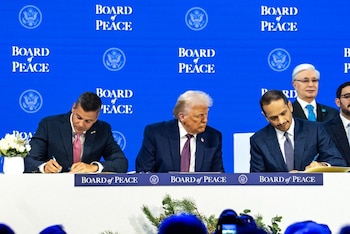
**The Summit Agenda and Objectives**
According to diplomatic sources, the summit agenda will include:
* **Economic and trade cooperation** between the United States and the invited Latin American countries, with a focus on agreements and alliances that reduce dependence on Chinese investment.
* **Shared security strategies**, particularly regarding critical infrastructure and emerging telecommunications technologies.
* **Political coordination in the face of China's global influence**, with a view to strengthening multilateral ties within the Western Hemisphere. ([infobae][1])
US officials have described the meeting as an opportunity to “form a united front” that can offer investment, trade, and cooperation alternatives to the Chinese proposals, although specific details are still under discussion and no formal statements have been released. ([infobae][1])

**Historical Tensions and Growing Rivalries**
The struggle for influence between Washington and Beijing has roots that run deeper than the current administration. For decades, the United States has considered Latin America its “backyard,” a perception that has influenced its foreign policy since the **Monroe Doctrine** in the 19th century. Trump has revived this rhetoric by emphasizing the need to limit China’s presence in strategic sectors of the hemisphere. ([La República][2])
Tensions have also intensified in other areas. Trump himself has adopted aggressive stances in his relationship with China globally, including canceling meetings with President Xi Jinping and threatening massive tariffs on Chinese goods for “hostile trade practices,” as reported by AFP in October 2025. ([infobae][5])}
For many analysts, the Miami summit reflects the United States' need to **recover lost ground** in a region where China has achieved a substantial economic presence through loans, direct investment, and fluid trade with countries like Brazil, Argentina, and Peru. ([LA NACION][4])
**Reactions from the Region**
While some leaders in the region have welcomed Trump's invitation, other governments have sought to maintain a balance in their international relations, taking advantage of both cooperation with the United States and the offer of Chinese investment and loans. The official position of many Latin American governments is to **defend their sovereignty and autonomy in foreign policy**, refusing to see themselves as pawns in a dispute between powers. ([The Republic][2])
**One isEvolving Scenario**
The Miami summit comes at a time of reconfiguration of international alliances, in which Latin America has become a center of competition among global powers. For Trump and his allies, the March 7 meeting will be an opportunity to reaffirm a shared vision of hemispheric security and economics, although the effectiveness of these efforts will depend on the ability to offer viable alternatives to Chinese influence, and on the willingness of Latin American countries to align themselves with Washington in an increasingly complex geopolitical context.
--


0 Comments