

The legendary driver, his family, and three other crew members died on December 18 after a failed emergency landing.
The tragic plane crash that claimed the lives of NASCAR legend Greg Biffle, his family, and the three other crew members of the private plane carrying them caused enormous shock in the world of motorsports. The immediate investigation launched by the National Transportation Safety Board (NTSB) yielded the first preliminary results of a report that will only have a comprehensive conclusion in 12 to 18 months.
After releasing images of the agency's agents inspecting the area hours after the incident at Statesville Regional Airport, details collected by the investigators were revealed, including some conversations that took place inside the cockpit of the Cessna 550 private jet during the few minutes the flight lasted.
From the recordings of the plane's black box, which contained about 31 minutes of audio, it was learned that the recording of the conversations began at 9:44 a.m. and the engines were started almost ten minutes later, although with signs of some malfunctions. “Engine start was initiated using onboard battery power, and after an initial unsuccessful attempt to start the left engine (No. 1), both engines were started at approximately 09:53,” the 8-page preliminary report states. Motorsport reported that the pilot of the aircraft was identified as Dennis Dutton and the co-pilot was his son, Jack.
The aircraft taxied to runway 10 to begin takeoff a minute before 10:00 a.m., with another conversation revealing symptoms of problems: “During taxi, the pilot and the two passengers with pilot licenses commented that the thrust reverser indicator light for an unspecified engine was not working, but that the affected engine's thrust reverser was functioning correctly.”
The flight began at 10:06 a.m. “under instrument flight rules (IFR)” with a final destination of Sarasota/Bradenton International Airport in Florida: the co-pilot performed the “checklist,” although just before takeoff he commented that “the left engine was producing more power than the right and indicated that there might be a faulty indicator,” however, “the pilot continued with the takeoff.”
After liftoff, the aircraft turned to the left and reached an altitude of 2,200 feet, but “the aircraft continued to turn to the left and began to descend,” while the co-pilot “attempted to contact” air traffic control three times over two minutes, but “was unsuccessful due to the controller's workload.”
The record indicates that at 10:09 a.m., the pilot and his companion in the right seat “discussed the possibility of climbing to a higher altitude.” The pilot in command of the Cessna 550 finally “initiated a climb,” seconds before the passenger in the back (presumably Greg Biffle) “observed a difference between the interstage turbine temperature indications of the left and right engines.” However, throughout the recording until the accident, “there were no further discussions about the engine instruments.”
The investigation found that one minute later... Following this event, the aircraft's autopilot was deactivated "intentionally" or "independently." The cockpit voice recorder did capture the pilot mentioning that his "altitude indicator was not working correctly and that other illuminated instruments on the left side might also not be working correctly."
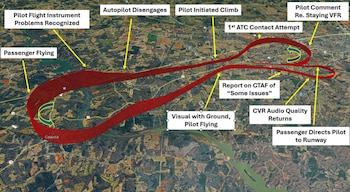
At 10:11, control of the aircraft was transferred to the co-pilot: "No comments were recorded during the rest of the recording that indicated any failure in the flight instruments on the right side of the cockpit."
The recovered recording subsequently showed a "serious" problem with the audio quality for more than three minutes. During that time, reports suggest that the pilot regained control of the aircraft and even requested that the landing gear be deployed, although "the landing gear indicator lights did not illuminate."
"We're having some problems here," was the exact phrase the co-pilot transmitted at 10:13 on the common traffic advisory frequency. They also heard the passenger in the back asking about the "alternator" power, and the pilot confirmed that "that was the problem," although it is currently unknown what the actual problem was and what actions were taken.
At 10:15, the pilot commented in the cockpit that he had sighted the runway, while the data shows that he decreased speed and began a descent. The last data transmitted by the GPS was at 10:15:23: "The indicated airspeed increased to 107 knots and then decreased to approximately 93 knots during the last five seconds of data."
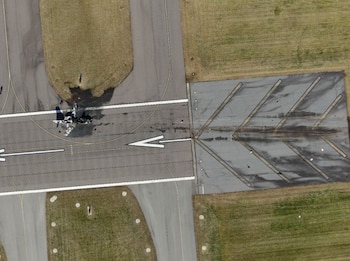
The An inspection of the accident area revealed that the initial impact during landing was against "the first light station of the approach lighting system" of runway 28. "A group of damaged trees" and "initial signs" of a fire in branches and grass were also observed. "A post-impact fire consumed most of the fuselage, and the heat damaged both wings," they noted, also observing damage to the tail and engines of the aircraft.
The pilot, who required a "second in command" to operate this type of aircraft, reported 17,000 hours of flight experience. The weather report indicated "calm wind" and "heavy drizzle" at the time of the incident.

Previously, in a press conference, the investigators had confirmed: "Yes, it crashed before reaching the runway. The post-impact fire consumed most of the fuselage and the inner sections of the wings. The plane struck trees, two other runway light poles, and the airport's perimeter fence, just before coming to a stop near the runway threshold."
The incident, which occurred on December 18, resulted in the deaths of seven people, including NASCAR legend Greg Biffle, his wife, his two children, and three other occupants. Cristina, his wife, and their two children (5-year-old Ryder and 14-year-old Emma) died in the accident, along with their friend Craig Wadsworth and the aforementioned pilots.

The racer became a legend in American motorsports, winning more than 50 races, including 19 in the Cup Series. He also won the Trucks Series title in 2000 and the Xfinity Series title in 2002.


0 Comments