

The film, which features Melania Trump as a producer, touches on her immigrant roots, her love for her mother, and her style, but there are few revelations.
Melania, the new documentary about U.S. First Lady Melania Trump, had a massive $35 million marketing campaign, an exclusive premiere at the Kennedy Center, and wide distribution in 1,500 theaters across the United States. What it lacked was much in-depth access or context from outside voices.
The cameras follow Melania Trump—who is also a producer of the film—for 20 days in January of last year, culminating in President Donald Trump's second inauguration. It's a fleeting period of time in a medium that typically spans years.
The brevity is presented as an advantage in what purports to be a first-person account. The director, Brett Ratner, who has reportedly been living in an eight-bedroom house at Mar-a-Lago, the Trump enclave in Palm Beach, Florida, accompanies Melania Trump on her travels between Florida, New York, and Washington, D.C., almost always alone and often in silence. She is reserved, even in her own film.
Moreover, little of the nearly two-hour film follows the conventions of nonfiction filmmaking, starting with the astronomical $40 million that Amazon MGM paid to acquire it from Melania Trump's own production company. What does it capture about the life—or “family, business, and philanthropy,” as she puts it—of the two-time first lady who is often seen wearing hats?

Here are a few clues.
There are few revelations.
Melania Trump is not known for being accessible, and the documentary confirms this. She is never seen in anything resembling an informal moment: she is always perfectly coiffed, made up, and in heels. (Her signature stilettos frequently appear front and center, although eagle-eyed viewers may spot her, once, in slippers.) The film follows her as she undergoes various wardrobe fittings for the inauguration, plans the events of that day and the weekend, and has several meetings with White House staff (some of whom are shown rejecting a press request about the Amazon deal).
She meets with Queen Rania of Jordan about initiatives for foster children and has a video call with Brigitte Macron, the first lady of France, about the harmful effects of screens on children. “No cell phones until 11,” she dutifully writes in a notebook with the logo of Be Best, the name of her youth well-being campaign.
The encounter given the most screen time is with Aviva Siegel, an Israeli woman who was taken hostage by Hamas along with her husband, Keith Siegel, who remained captive at the time of filming. (He was later released.) She cries as she talks about her husband, and the first lady leans in to comfort her.

Otherwise, Melania Trump is mostly heard in voiceover. She narrates the entire film, offering facts about the places she visits, such as Arlington National Cemetery and Blair House, where incoming first families stay before the inauguration. Sometimes she articulates her goals as if delivering a political speech. “I will always use my influence and power to fight for those in need,” she promises.
A Mama's Girl
The closest viewers get to the protagonist's inner life is through her numerous references to her “dear mother,” Amalija Knavs, who died in January 2024. In the film, she often speaks of her grief and her mother's influence, a former patternmaker to whom she attributes, in part, her love of fashion. She calls Knavs “the richest thread in my life,” whose “quiet strength shaped me.” On the anniversary of her mother's death, she attends President Jimmy Carter's funeral in Washington and, back in New York, goes to St. Patrick's Cathedral to light a candle for her mother. She speaks openly about her immigrant roots.
Donald Trump only appears with “my husband,” as she almost exclusively refers to him, at ceremonial or official events. There are some phone calls between them, but no private dinners together or interactions outside of their political duties. (At a meeting to finalize inauguration details, the president asks her if she has chosen her dress yet.)

Notably, in an administration whose anti-immigration policies have fueled violence, the people surrounding Melania Trump are immigrants: there's Hervé Pierre, her French fashion designer, a friend for more than eight years. (“Happy anniversary,” they say softly in the film, when the date is mentioned.) After 22 years in the United States, Pierre became a naturalized citizen shortly before dressing her for the first inauguration. He enthusiastically says that, as a former model, she and he speak the same language.
The language is that of sartorial details and tailoring.
Tham Kannalikham, the interior designer responsible for the White House's transformation under Trump 2.0, describes how her family left their native Laos when she was 2 years old, and how the opportunity to work at the presidential residence became part of her American dream.
And Melania Trump herself speaks of her “immigrant journey” from Slovenia to the White House, “a reminder of why I respect this nation so deeply,” she says. “Everyone must do what they can to protect our individual rights. Never take them for granted, because in the end, no matter where we come from, we are united by the same humanity.”
When her father, Viktor Knavs—one of the few people to give an on-camera interview—appears, he speaks mostly in Slovenian while his daughter smiles beside him.

She is proud of how Barron Trump has handled public life.
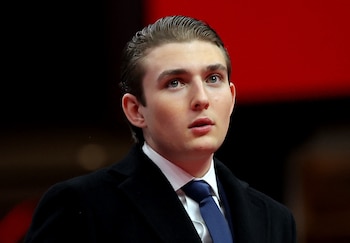
Barron Trump, now 19, is seen but almost never heard in the film. (Trump's four stepchildren have even less impact; she never mentions them.) She does speak of her pride in how her son has handled his unusually public childhood; he was 10 years old at the start of Trump's first presidency. As he grows up, “it’s very important that he lives the life he wants to live,” she said, even in their cloistered world.
But family safety is a consideration. As the Trumps discuss security surrounding the inauguration parade motorcade, Melania Trump says her son would not be getting out of the car: it's his choice. When the public festivities are finally moved indoors due to the extreme cold, she confesses to feeling relieved. “Being in a safer, enclosed space gave me some peace of mind.”
She leaves no room for gray.
The first lady's graphic palette—“very symmetrical, right angles, black and white,” as her closest advisor, Marc Beckman, recently described it—is all over the screen. From the opening scene, when she emerges from Mar-a-Lago in an alabaster shirtdress and snakeskin heels to the strains of the Rolling Stones’ “Gimme Shelter,” she is frequently shown in crisp white blouses, dark trousers, oversized sunglasses (even indoors), and the wide-brimmed, shade-providing hat she wore for much of Inauguration Day. Her image, clearly, is paramount.
The film’s promotional materials also adhered to her preferred austere color scheme; even the commemorative popcorn boxes—which could be yours for $12.99—are a stark black and white.
Beckman, who is also a lead producer on the film, said the styling was part of Melania Trump’s plan to create a luxury brand. (Given her current residence, perhaps she took inspiration from a retailer: White House Black Market.)
This Is How She Sees Herself
By all accounts, Melania Trump had significant control over the project, including the choice of Ratner, a filmmaker who hadn’t worked in Hollywood since 2017, when six women accused him of sexual misconduct. (He denied any wrongdoing.)

The vision the film presents of her—heavily focused on style; still grieving her mother; frequently alone—is, therefore, presumably the one she endorses. The documentary ends with a lengthy list of Melania Trump’s accomplishments before the credits roll, none of which are actually shown in action.
While it doesn’t clarify who she is, the film does tell us how she wants to be seen.
© The New York Times 2026.


0 Comments