
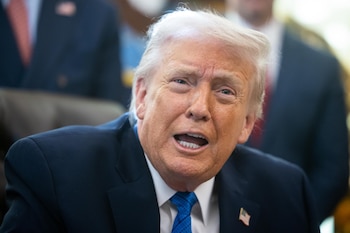
The US president claimed that the Islamic Republic “is negotiating” with Washington. Masoud Pezeshkian, the Iranian head of state, affirmed that a war would not benefit either country “or the region.”
Donald Trump stated that Iran has initiated a dialogue with his administration, amidst weeks marked by warnings and threats in the Persian Gulf region.
“Iran is talking to us, and we’ll see if we can do something, otherwise we’ll see what happens... We have a large fleet deployed there,” the US president told Fox News, in a clear reference to the increased US military presence near Iranian territory.
He added: “They are negotiating.”
From Tehran, the regime offered both confrontational and more conciliatory statements. Head of State Masoud Pezeshkian declared that “the Islamic Republic of Iran has never sought, nor does it seek in any way, war, and is firmly convinced that a war would not benefit Iran, the United States, or the region.”
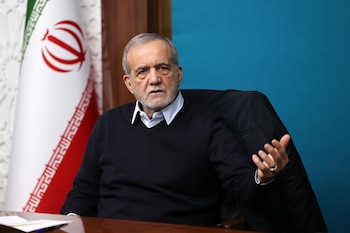
Along these lines, the head of Iran's National Security Council, Ali Larijani, acknowledged the existence of diplomatic contacts with Washington amidst the tense climate. According to IRNA, Larijani attributed the perception of a lack of dialogue to “war propaganda” and maintained that a “negotiating framework” is underway, without specifying timelines or conditions.
Regarding the conditions for a possible rapprochement, the positions of both countries remain at odds. According to IRNA, Iranian Foreign Minister Abbas Araqchi indicated from Istanbul that “we will preserve and expand our defensive capabilities to the extent necessary to defend the country.” Araqchi specified that any agreement requires excluding Iran's ‘defense capabilities’ and the development of ‘ballistic missiles’ from the negotiation process, in addition to demanding that all dialogue take place without pressure or threats. The United States, for its part, demands a halt to the Iranian missile program as a precondition for progress and maintaining the sanctions regime, a position not accepted by Tehran, which conditions any significant progress on the prior lifting of sanctions. The military dimension of the conflict has also gained momentum. According to The New York Times, the U.S. Navy is maintaining the aircraft carrier Abraham Lincoln in the Arabian Sea, accompanied by ships equipped with Tomahawk missiles, F-35 fighters, and F/A-18 aircraft. This naval group, under the control of U.S. Central Command, operates with the capacity for immediate response against potential targets in Iran, seeking both to deter Tehran and protect strategically important trade routes.
Central Command warned this Saturday that it will not tolerate "unsafe" maneuvers by the Iranian Revolutionary Guard, especially during exercises in the Strait of Hormuz, a crucial passage for global energy transit. The United States considers both close flyovers near its ships and aggressive approaches by Iranian vessels dangerous, as these incidents increase the risk of clashes and destabilize the region.
In response, the Iranian Revolutionary Guard conducted two-day naval maneuvers with live fire in the Strait of Hormuz to strengthen national defense. According to IRNA, these operations took place shortly after the force was designated a "terrorist organization" by the United States and the European Union, a label firmly rejected by Iranian authorities.
In addition, various regional actors have activated diplomatic efforts to curb a possible military escalation. The Prime Minister and Foreign Minister of Qatar, Sheikh Mohammed bin Abdulrahman Al Thani, visited Tehran in an attempt to reduce tensions. Meanwhile, leaders from Turkey, the United Arab Emirates, and Saudi Arabia have intensified diplomatic efforts, while the arrival of a U.S. destroyer at the Israeli port of Eilat confirms the increased international military presence in a key area for the flow of oil and gas.
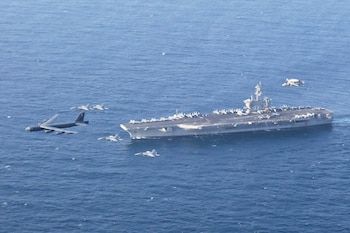
The tension in the Strait of Hormuz is putting pressure on global energy trade, as most international crude oil transit passes through this strategic corridor. An incident in the area would have serious implications for regional stability and global supply.
Domestically, despite international pressure, Iran maintains that its scientific and technological advancement, as well as the defense of its nuclear program, remain a priority. Authorities in Tehran insist they will not back down in these areas, even in the face of external threats.
Given the latent risk of conflict, Iranian leaders have warned of the consequences that a miscalculation would have for both local actors and international alliances, emphasizing that the instability could spread far beyond regional borders.


0 Comments